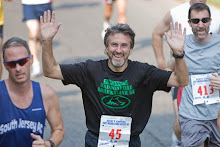
I entered my first race since 2004 where I have had a goal this past weekend - the Lupus Loop 5K in Philadelphia. My goal was to break 19 minutes - we have that as our qualifying time for Varsity on the Moorestown Cross Country team, something that 20 of the guys have achieved this year. I felt I was in shape to do around that, although I have not really done any speed work and little threshold work.
Well, I blew it. I ran 19:02, which was monumentally disappointing to me. I blew it in two ways. First, I kind of fell asleep in the middle of the race. Maybe it was trying to be conservative with the first fast race I have run in a long time. Maybe it was the Evil Mini-Bob on my shoulder telling me that it was just easier to go slower. Where I really blew it was the long straight finish. I thought I was going to make it no problem. There was a guy ahead of me, and I really do not like to showboat and blow by people in the last 400 meters. Anyway, I stayed just behind him and then with about 10-15 seconds of race left I realized I was not going to make it. A real bummer...
So I made two mental mistakes, but 30 years ago I could have run much faster. So the idea came to me to ask where did I lose it? Well, it is in three areas:
- Weight gain
- Age
- Training
Looking at weight gain, I have gone from about 135 pounds to about 155 pounds - or about 61 kilograms to 70 kilograms. If I reference back to Jack Daniels basic ideas of VDOT and VO2Max, I see that the 19:02 is roughly a 55 VDOT (there were some hills on the course). 55 * 70 kg = 3850 units of oxygen my body is able to process. If I then divide this by the 61 kg that I used to be, I found my VDOT would be about a 63. So my weight gain is worth about 8 VDOT points - if I check my chart, that translates into about a 17:00 5K. So by extralopation, if I lost 20 pounds and returned to my college running weight I would be able to run 17:00.
Next, I looked at the age factor. I used a website to help me understand this. It says my 19:02 would be worth about a 16:40 if I was not so darn old.
Now this makes me wonder how to add these two factors together. If I use the VDOT factor first, and translate the 17:00 time if I weighed 135 again, and then apply the age factor it drops me down to a 14:50. If I go the other way, and use the 16:40 time if I was in college again, that gives me a VDOT of 63. Add 8 VDOT points and it gives me a 71 age and weight adjusted VDOT - which would put me at around a 15:30. Hmm, I like the first method.
In reality, if I had run all out when I was in shape on that course in college, my guess is I would have done about 14:20-14:30. But I was not going all-out even in my current condition - so let's say I would have run around 15:00.
This analysis puts me around the right ballpark. But the third factor is a pretty big one. My conditioning is not nearly what it was. I was running 100 miles per week and doing some pretty hard workouts and races, while today I run about 25-30 miles per week and do not train hard. My resting hear rate was around 32-34 beats per minute and it is around 42-44 now as one example of not being in the same shape.
I think the error factor comes in the fact that the age based rankings probably take into account the fact that older guys weigh a bit more than younger guys. There is also the fact that there are multiple variables being used here, that are based on tables compiled on experience. So the numbers are bound to be a bit off.
Nonetheless, I am hoping this provides me with a bit of motivation to maybe lose a few pounds. And maybe train a bit more. It was fun to run kind of fast again (even with the extra baggage and years). Maybe I will try to find a 5K before the XC season ends and qualify for Varsity...
Monday, October 27, 2008


Sunday, October 26, 2008
Moorestown Cross Country Course
One of the great accomplishments of the Moorestown Cross Country Team was the building of their own home course. This has been a long endeavor that started in 2005. You can read some of the history here. And here and here.
We got a nice article written in the Philadelphia Inquirer. They really captured the spirit of the team in persevering thru 3 years of effort that required about 600 hours of volunteer effort by the Moorestown Cross Country Team. And we learned that it takes cooperation across a wide range of people and groups.
I recall the first day we ran as a team on the trail as it neared completion. Nearly 70 guys running thru the woods cheering and shouting. I wish all of our benefactors had been there to see that. And we got a LOT of help and support, since the multiple phases cost us about $30,000. So special shout-outs to Leonberg Nurseries, Moorestown Alumni Association, Moorestown Rotary, Family Fun Day, RBC Wealth Management, Long & Foster Realty, and the Moorestown Education Foundation!
Chris Barr, a runner from the early 1960’s teams at MHS, was kind enough to make a map of what the course looked like back in 1963. The course was down at Memorial Field and Strawbridge Lake and on the roads for almost 1/3 of the race. At some point in time in the 1980’s the course transferred over to the high school, but involved running on the roads in Stanwyck Glen. This got outlawed by the State in the 90’s and the team has been without a home course since then.
Monday, October 6, 2008
Long Distance Motivation
One of our runners came up to us after practice yesterday and asked "Runner X does not run as many miles as I do and yet he beats me in races. Why?"
I buy into the logic that runners are good because of three things:
1. Natural ability to deliver and burn oxygen and fuel in their bodies to produce the energy to move them forward (Jack Daniels VDOT). In other words, some people are built with better engines.
2. Mental and nerve system ability. This is a combination of being able to deal with pain as well as being able to run a race well (even pacing, competitiveness with other runners, etc.).
3. Conditioning. How have they conditioned their bodies to best tune their engines. Lots of debates on how this is done - miles, speedwork, thresholds, cross training, etc. But it is clear that people can run faster if they train, and up to a point get better as they train more.
On the logical level, the answer to his question is that some people have better cardiovascular systems, more efficient bodies and strides for distance running and have better abilities to deal with the pain and logistics of a race. Tough luck that someone has a better #1 and #2 even though you feel you work harder.
This seems like such a stark answer. But if you think about it, every runner faces this. Ringwood is the best runner on the Moorestown team right now, and the other 60-70 guys think he is amazing. However there were 35 guys that were faster than him at Holmdel on Saturday. Should he feel frustrated that he only ran 16:44 and Brett Johnson ran a minute faster? In essence, Ringwood could ask the same question this runner asked.
I would propose that the answer comes back to something I call "long term motivation". It kind of fits with "long distance running". Just like distance races last a long time - 15 minutes for a 5K compared to 10 seconds for a 100 meters, or 2-3 hours for a marathon vs. 45-60 seconds for a 400 meter race - long distance runners need to think of their training in a similar way. And I don't mean a single 10 mile run - but years of running to improve the complex systems in their bodies. And even with years of training, it is more likely than not that there will be lots of people better than you.
Therefore to be in this sport, you need long term motivation. The first thing is to find joy in the simple act of running. Some people talk about a "runners high". I'm not sure I have ever experienced that, but I do enjoy the simple act of going out for a run. It feels good, it helps you get away from the rest of the world, it makes you feel like you accomplished something.
The second key to long term motivation is having a set of short term goals and milestones that are realistic and achieving them. These are goals for a particular race or a season. Near term things that measure whether the work is producing some positive results. On our team we focus on Personal Records. It is something that every runner can celebrate from the front of the pack to the back of the pack.
The third key to long term motivation is having a long term plan and set of goals. A freshman coming in to the team should realize they have a tremendous advantage of saying they will work hard over the course of 4 years and get a whole lot better over that time. Ben Friedman is a great example of this. There may in fact be other people on the team that have more talent (#1 And #2 above) than him, but there is no one on the team who has ever worked harder than Ben. He has put in more miles and has worked harder in each individual workout. He took a long term approach and that is paying off for him – last week he went sub-17 at Holmdel with the 8th fastest time ever recorded at Holmdel by a Moorestown runner.
The final, important piece to long term motivation is being part of a team. A group of people you can share your experiences with, the good races and the bad, the training miles, the tossing of frisbies, the jokes during stretching. High school and college teams offer the best environment since there are team-related goals to point toward. Being a part of the team competing for those goals can make a huge difference. From a personal perspective, this was the key aspect that motivated me at Bucknell. Coach really had us focused on running together and helping each other, making team oriented goals that would motivate all of us to work hard and work together.

Dave Simpson (the guy in the middle without his shirt holding the mascot Elk Head) was the best example in my mind of a runner who was motivated by the team. In 2005 we had a very good team that won Group 3 Sectionals and finished 2nd in State Group 3. He was a Captain on the team and had worked very hard all summer and fall to make the top 7, but was edged out by other runners who had a bit more of #1 and #2 above. If you ask any member of that team, they will say Dave was a key part of that team. From my perspective, he was one of the best Captains we ever had. He was a natural leader. He made practice and races fun. He reached out to everyone on the team to make them feel good and to encourage them. And I know he had a heck of a lot of fun running cross country. He had long term motivation for the sport – he enjoyed the training, being with the team, and his role as a leader on the team. Certainly he was disappointed that he was not on that final Top 7 who ran, but he was proud of the role he had in leading that team.
Which gets me back to the question the runner asked us yesterday. We tried to explain this concept that he had to have a long term motivation for the sport. I hope he reads this and it helps put things into perspective some. I hope he internalizes our guiding principles of Team, Work, Learning, and having Fun. I know he can be an important part of this team. Maybe in the way Ringwood is, maybe in the way Friedman is, the way Dave Simpson was, or his own new way that helps himself and the team.
Friday, September 26, 2008
Moorestown XC from 1966
I got an email from Chris Barr, a graduate of Moorestown in 1966. Here is a great description of the team back then:
"Although we were second at the Bridgeton Meet [our equivalent of the So. Jersey All-Group Meet] and fourth at states, we were seven individuals. That 1963 team eventually had one sub-12:20 runner, two sub-12:30 runners, two sub-13:20 runners, one sub-13:40 runner and a sub-14:00 runner for Moorestown's 2.5 mile home course [one senior, two juniors and four sophomores]. I don't know what mileage the others ran over the summer; but, I remember I put in about 21 miles/week [3 miles a day, seven days/week]. Each day I ran about as hard as I could, developing a 600 yard drive at the end of each race. It may be age catching up to me; but, I do not remember ever being passed during the last 600 yards my senior year. I remember the Edgewood coach telling me my sophomore year, that if you are in shape, winning is 90% desire. That credo won many a race for me. In hindsight, I regretted not sharing this with my teammates."
Three sub-12:30 is roughly equivalent to sub 16:50 at Holmdel today. Pretty darn good team...
Thanks for the memories!
Friday, September 19, 2008
First Batch Meet
Cinnaminson has a good XC team. They beat our Moorestown team this past Tuesday in the first batch meet of the season 26-29.
They were led by Todd Campbell, who was only 1 second off Steve Grabowski’s 16:19 course record. Ben Friedman (M) ran the whole way on his shoulder before Campbell broke away in the final 600 meters. Friedman ran a 16:27 – good enough for 3rd best on the all time list (actually 4th now), ahead of Jon Anderson’s time from 2002.
They went our in a 5:25 first mile, then Campbell picked up the pace for a 5:04 second mile. This stretched the field out and gaps developed in 3-10th place.
Steve DeLuca (C) has made a big move forward this year (Holmdel best of 18:10 last year) and ran a 16:50 for 3rd place, ahead of Dave Ringwood (M) at 16:53. Alex Matteson ran a nice race at 17:05 – all top 20 times on the all-time list for a course that goes back to 1995 and has seen some fast runners.
Todd Campbell (C) 16:20
Ben Friedman (M) 16:27
Steve Deluca (C) 16:50
Dave Ringwood (M) 16:53
Alex Matteson (M) 17:05
Dylan Tooher (C) 17:13
Damien Clayton (C) 17:16
Brandon Greenwood (M) 17:38
Ian Dill (C) 17:42
Ryan Wolff (M) 17:45
Joel Robinson (M) 17:46
Sam Weintraub (M) 17:47
Tyler Ems (M) 17:55
The good news for our Moorestown team is that we had 10 guys set PR’s of over 1 minute from last year – most of those coming from runners who had made a more serious commitment and did a lot of summer running. Of the 64 total runners we had compete, there are 51 PR’s (many of them coming from new runners establishing their first race time at 5K.
Saturday, September 6, 2008
Relaxed Running
After Usain Bolt won the Olympic 100, setting a World Record, I heard so many people comment “think how fast he could have run if he had not eased up”. I take the counter view – think how much slower he would have run if he was running tight?
Go to any high school (or college) cross country meet this fall. You will see the people who finish at the top look relaxed when they run and the further back in the pack you get, the more the runners seem to labor. Certainly part of this is explained by conditioning. But each runner is running at their maximum – I doubt Bret Johnson is not trying as hard as the guy who finishes 100th in the race. Yet Johnson will look light and easy, with a relaxed facial expression, limber arms and fingers as he blazes up the final 200 meters of grass on Holmdel.
I wrote a blog that form does not really matter. I think what matters more is the efficiency and focus of energy into the effort of moving your body forward. Clenching a fist, scrunching up your face, tensing of any muscle does not make you move forward any faster. In fact, it saps energy from your body. It uses up valuable oxygen on the wrong muscles, and can cause a chain reaction that makes your stride tighter and less efficient.
Back when I was in high school I got into Transcendental Meditation a bit. It is a technique to teach your body to relax and become more aware of yourself. One day during my junior year of track, I did an experiment to try to transfer some of the things I had learned from TM onto the track. I had noticed that the best runners really looked very relaxed and I felt that maybe if I found a way to relax, then I would be able to run better.
It was a dual meet against Catholic Central, and they had a great two miler. I decided my strategy would be to forget about everything else in the world and just focus-in on staying right behind him and zeroing in on his feet. For about 7 laps I was able to keep nearly a total concentration on his feet and forget about everything else and become very relaxed. He dragged me to a 20 second PR and got me close to the magical 10 minute mark.
I still use TM methods when I am running in a race. I close my eyes a bit and actually slow by breathing and breathe more deeply. Focus on making sure my muscles are relaxed – the shoulders loose, the hands unclenched, the stomach just breathing in and out.
Maybe Bolt could have run a 9.65 that day, but I doubt he would have enjoyed it as much…
Pack Running
Running in packs is something we pride ourselves in at Moorestown. It is something I learned at Bucknell from Coach. He had one philosophy above all else – “The strength of the pack is the wolf, and the strength of the wolf is the pack.”
Every runner in every race always has questions going thru their mind “can I keep this pace”, “geez, this hurts”, “maybe I’ll run harder and better next week”. Running in packs helps to get rid of these questions.
In 2005, we had Dan Rinehart, Eric Holaday and Ben Leonberg as seniors who really adapted to that strategy of pack running. They were all about equal in capabilities, yet each had different strengths. They would run together the first couple of miles of the course – using each other as a guide post of where they were in a race. It is always easier to know where you are in the big races at the end of a season if you have your buddies around. They pushed each other to performances (all were sub-17 at Holmdel) that were better than they could have achieved alone. The last mile (and sometimes the last 400 meters) would decide who was better that given day.
I had a similar experience in college with my roommate Lee Edmonds. “Eddie” and I were about the same level of runner coming into Bucknell. Coach put us together as roommates – in my mind he saw something in each of us that would feed off of the other. Eddie and I tied about 80% of our races in college and probably split the rest. Eddie would always start off slowly, but we would always be together by the mile point. There was something comforting about him sliding up next to me “Hey Bic”, “Hey Ed”. If any of those little voices crept into my head about wanting to slow down, I was able to fight them back primarily with the thought that I did not want to let Eddie down.
We also used this to our competitive advantage. I remember running the ECC championships at Belmont Plateau. Mike Glavin of St. Joe’s was right on our back coming up “Sure Kill” the big hill that goes above the Schuylkill Expressway. We worked the hill pretty hard and when we got to the top he was still there. I said in a voice loud enough so he could hear “Ready to go now Ed”. We heard a grunt behind us as we pressed on the flat area at the top of the hill for only about 200 meters and broke free.
I was up at Bucknell this past weekend. While Coach is gone, the team still uses the pack mentality when running. Helping to feed off of each other. Encouraging each other to reach new levels. And making the achievement of those new levels meaningful.
We’ve adopted Coach’s quote for the Moorestown team. We’ve also added another one – “Why run hard? For yourself. For your team.”
Subscribe to:
Posts (Atom)

 Posts